Global web icon
wikipedia.org
https://en.m.wikipedia.org/wiki/Displacement
Displacement - Wikipedia
Displacement (geometry), is the difference between the final and initial position of a point trajectory (for instance, the center of mass of a moving object). The actual path covered to reach the final position is irrelevant.
Global web icon
howengineeringworks.com
https://www.howengineeringworks.com/questions/what…
What is displacement? How is it different from distance?
Displacement is the shortest straight-line distance between the initial position and the final position of an object, along with the direction. It is a vector quantity, meaning it has both magnitude and direction.
Global web icon
clrn.org
https://www.clrn.org/what-is-displacement-in-physi…
What is displacement in physics? - California Learning Resource Network
Displacement is a cornerstone concept in physics and engineering, providing a precise measure of an object’s change in position within a defined frame of reference. Unlike distance, which is a scalar quantity representing the total path length traveled, displacement is a vector quantity.
Global web icon
merriam-webster.com
https://www.merriam-webster.com/dictionary/displac…
DISPLACEMENT Definition & Meaning - Merriam-Webster
The meaning of DISPLACEMENT is the act or process of displacing : the state of being displaced. How to use displacement in a sentence.
Global web icon
britannica.com
https://www.britannica.com/science/displacement-me…
Displacement | Newtonian, Conservation & Vector | Britannica
Displacement, in mechanics, distance moved by a particle or body in a specific direction. Particles and bodies are typically treated as point masses—that is, without loss of generality, bodies can be treated as though all of their mass is concentrated in a mathematical point.
Global web icon
khanacademy.org
https://www.khanacademy.org/science/physics/one-di…
Displacement (article) | Kinematics | Khan Academy
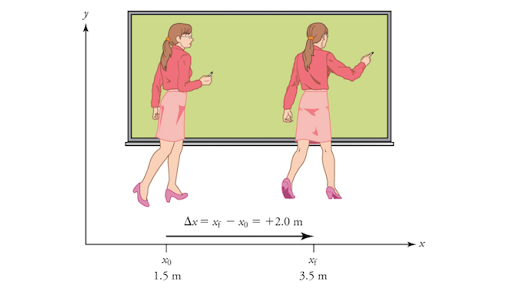
This equation says that displacement is the change in an object's position, or equivalently, the difference between the object's final position and initial position.
Global web icon
umass.edu
https://openbooks.library.umass.edu/toggerson-131/…
Displacement – Physics 131: What Is Physics? - UMass
Always solve for displacement by subtracting initial position from final. Note that the SI unit for displacement is the meter (m), but sometimes kilometers, miles, feet, and other units of length are used.
Global web icon
msu.edu
https://openbooks.lib.msu.edu/collegephysics1/chap…
Displacement – Introductory Physics for the Health and Life Sciences I
Displacement includes both magnitude and direction. It is a vector quantity, which means it can be positive or negative depending on the direction of motion. For example, if we define motion to the right (or east) as positive, then any motion to the left (or west) is considered negative.
Global web icon
libretexts.org
https://phys.libretexts.org/Bookshelves/Conceptual…
1.2: Displacement - Physics LibreTexts
Distance is defined to be the magnitude or size of displacement between two positions. Note that the distance between two positions is not the same as the distance traveled between them.
Global web icon
physicsclassroom.com
https://www.physicsclassroom.com/class/1DKin/Lesso…
Distance versus Displacement - The Physics Classroom
Distance is a scalar quantity that refers to how much ground an object has covered during its motion. Displacement is a vector quantity that refers to how far out of place an object is ; it is the object's overall change in position.